
on forgiveness
contemplations on religion, blame, identity, compassion, and the power of forgiveness

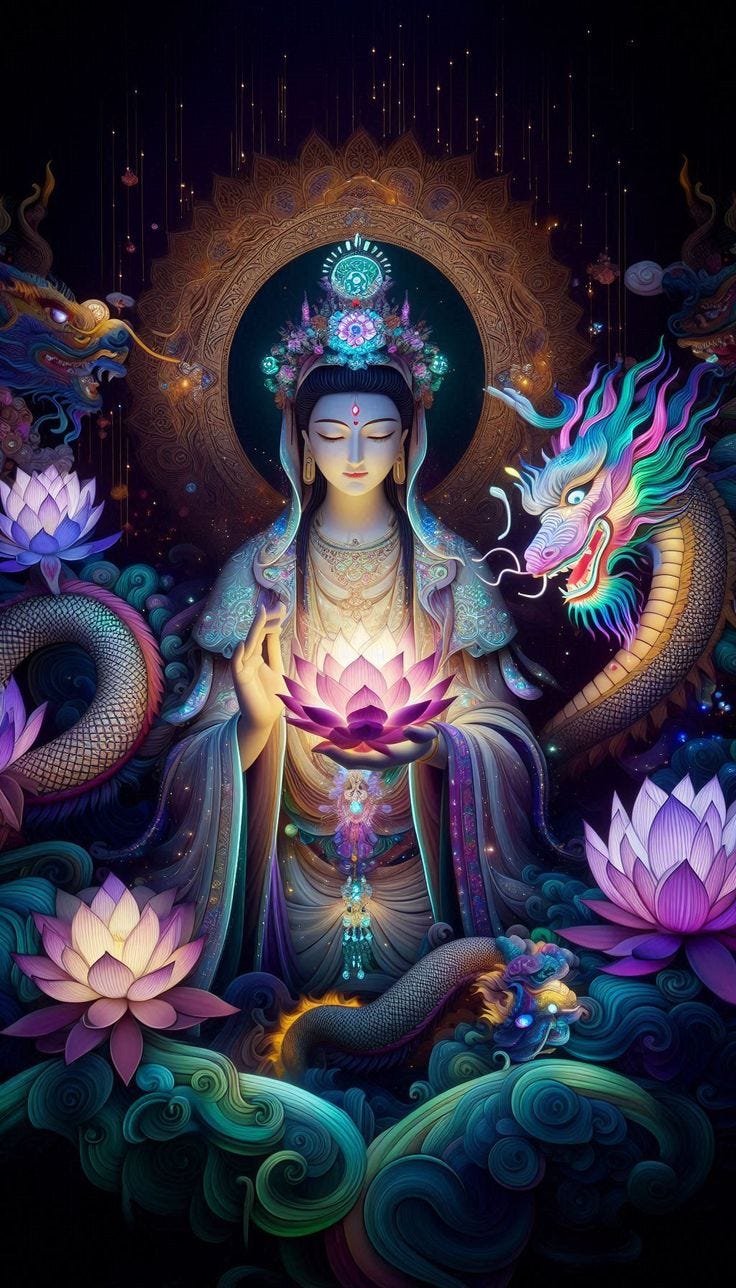
“A person is a person through other persons. None of us comes into the world fully formed. We would not know how to think, or walk, or speak, or behave as human beings unless we learned it from other human beings. We need other human beings in order to be human. I am because other people are.” ~ Desmond Tutu
Forgiveness is an unrelenting force. Kuan Yin rides the dragon of it and relieves the suffering of the world.
Without forgiveness, truth lives tucked beneath fictional tales, masked behind similes, thrashing wildly beneath stories and myths and academic degrees and certifications and accomplishments. For many years, I paddled fast to keep my face afloat, smooth and serene at the surface of an untamed underworld. But exhaustion, depression, disease, grief, and economic anxiety are unrelenting lie detectors.
These are the questions I asked and life answered:
What if every sensation and experience is pushing you to give up on who you never were so that you can become whole? What if a nervous breakdown is actually an awakening?
Yes.
~~
We create our goddesses and gods to explain ourselves to each other just as we create stories of each other to decipher the meaning behind experiences we cannot understand. Some moments feel threatening. Others are pure joy. Myths have their dark sides and their reasons.
When the world begins to unravel, I dive deeper into the shadows.
I told a story for half my life about how a religion and a homeschooling cult damaged me beyond repair. It’s only partially true. My adventurous spirit was cornered and reprimanded for failing to comply and align with a set of rules established by someone whose intentions I can never know. My ego fragmented. I lost myself very early in life. But no one is ever beyond repair.
If any of us are victims, we all are. We are mirrors. The choices we make are influenced by our contrasts and projections. A perception of another reflects an internal world, our own overlaid on theirs. I can blame the man who led me to despair, sure. But then he continues to control me. And if I am not the sum total of any of my decisions, then neither is he. In one lifetime a perpetrator, in another a victim. When do we become free?
I no longer wish to limit and define people, including myself. We are so much more than the identities we play out in our short lives.
Forgiveness is the dragon that frees us.
~~
When my parents told me they would be enrolling us in the Advanced Training Institute of America (ATIA) homeschooling program, I didn’t think too much of it. My brother and I were already homeschooled. It’s a curriculum change, I may have thought, nothing more.
We had just moved to California, the sixth state our family had lived in within the span of my eleven years. My head was foggy. Uprooted from the beginning, I floated in and out of learned behaviors, vigilant of local social norms that changed with every location. I was most at home in a car, moving between homes, detached from everyone and everything. Homeschooling was a thing we did so that we could move often with less hassle.
My parents were two of many inspired by Bill Gothard. His teachings integrated Bible stories and old-fashioned mores as if the two were intrinsically connected, from gender roles to fashion. I was to wear long skirts and buttoned up shirts. My brother was to keep his hair short and his shirts tucked. We went to seminars with other families occasionally but mostly we used the curriculum at home. We were taught new definitions of words. Sin could look like a skirt cut above the knees or enjoying a love song on the radio. Eventually I went to a two-month long ATIA school for girls. There we learned to sew, arrange flowers, sing in harmony, and how to be submissive. The activities themselves were innocent and folk artsy. But there was a sinister feeling too. We were to rise at 5AM and recite scriptures to our team leader. We were always under supervision by a peer if not a leader. There were no choices, no options. I spent hours in the old abandoned kitchen at the back of the renovated hotel that housed us. Every time I committed an infraction - sucking on a lollipop, wearing the wrong color, being late for a meeting, having a different opinion - I was sent to the old kitchen to write essays about the value of obedience. Once, a teacher told me I reminded her of O.J. Simpson: the look of callousness on my face when she accused me of being deceptive and rebellious about the candy I’d had in my pocket. I was 16 years old.
~~
Blame is cold and cutting. It feeds hatred of self, other, and humanity. It can chill us until the muscles and bones around our hearts are stiff and achy. Buddhaghosa’s Visuddhimagga says of hatred: “It is throwing cow dung at another: you dirty your hands first, before you dirty others.” Dalai Lama XIV offers the flipside of this notion in The Book of Joy: “... in African villages, one would ask in greeting, ‘How are we?’ This understanding sees that someone else’s achievements or happiness is in a very real way our own.”
Blame disempowers.
Humanity collectively moves through the days hearing of false triumph and endless new excuses for torment. We blame one or the other in a learned powerlessness that keeps us whirling about in a collective icestorm. Immigrants have been arrested and sent away. Families have died by genocide. I live in a country where people are killed, locked up, left out, and punished for every mistake or simply for how they look. While others get away with literal murder.
How are we?
We are always fighting a part of ourselves, the parts we’re ashamed of or afraid of because we don’t understand the full story of us.
If one of us is violent, we all are. If one of us is tortured, we all are. We watch the news and then we fight as if there is no connection between us, as if we can possibly live separately from one another.
Forgive us all.
~~
At Garfield Park Conservatory I sit next to the broad, bright green leaves of cavendish plants. Miniature bananas are lined up like tightly wrapped infants under expansive upper canopies. Tall, slender ginger trees with their lance-shaped leaves and bright pink blossoms look like creatures from a fairyland. The damp warmth of the room soothes my winter skin. There is so much beauty here. Blossoms symbolize the prosperity of simply being alive. Later, I notice the pink cast of the sky and remember: we live in a world with a pink sky, and orange, and blue, and purple and red. It’s for all of us, and yet so many of us are cast into the shadows, away from the beauty and ease.
Forgive us for taking the earth for granted, for all the times we’ve ignored her beauty and taken advantage of her abundance.
~~
I thought I couldn’t. Couldn’t speak from my heart, couldn’t fall in love with people who truly loved me too, couldn’t belong, couldn’t be comfortable, couldn’t feel safe, couldn’t be happy for more than a split second.
I blamed religion and ATIA because that was where I felt the most shattered, as if I had to remove whole limbs from my body. Desires and emotions were infectious, contagious, of the devil. I stopped letting myself feel anything fully. My body locked up like a wall around the soft flesh of my heart. The only emotion that felt alive was anger. I’d let anger out sometimes. Depression felt like a grave. I couldn’t breathe for many years. I held my breath. I thought that was life.
When I first learned that not everyone experiences suicidal ideation, I was stunned. Now I think perhaps we just call this existential loneliness by different names: suicidal ideation, heavy drinking, workaholism, political conflict, binging and purging, overachievement, underachievement, drama, perfectionism.
~~
When you are beside yourself you are upset, you are in a tizzy, unsure, lost, confused. I like to sit beside people who are beside themselves. I want someone to sit beside me when I’m not able to sit inside myself. To stay inside oneself when chaos feels like an internal explosion - this is a practice of self-love. Sometimes, though, we need someone else to remind us how to be still in the storm.
It’s hard to ask for help.
Instead of asking for help directly, we as a collective seem to be acting out. We are throwing tantrums. We are hitting to get our way. We are calling each other names and using words like hate. But we cannot escape each other in the same way we cannot escape ourselves. We are in this together. Life is both pain and joy. We are needy and we save each other. Pop psychology and social media have made connecting hard and healing even harder. They are faux solutions to an intricate world that is ever shifting and growing within us and between us. What if connecting and accepting is all we ever really needed?
~~
We offered weekly confessions to our parents. I called mine and told them I smoked sometimes. I told them about the warm beer I kept stashed in my bag. My mom had once uncovered a Whitney Houston cassette tape under my mattress. I was grounded for a week so I stopped hiding things in my room and carried them with me instead. My backpack became a Mary Poppins bag of cliche and fairly innocent teenage curiosities. A pack of cigarettes. A condom that never got used, the text on its wrapper eventually fading. A book. Mixed tapes. A damning set of poems I’d written about everything that scared me, wounded me, and intrigued me.
ATIA was meant to break us down. The will of the child must be broken is one of many of its axioms. A child who disobeys is better off dead. A girl who wears a v-shaped shirt invites sexual assault. Did they mean to instill fear? Did they really believe women and children were deserving of violence? I can’t say for sure. But I allowed these beliefs into my body and carried them like steel animal traps that would pull tighter around my mind every time I tried to walk away. I am not good enough. I am a bad person. I stood in front of my mirror and hatefully criticized every inch of my face and my body. I am ugly. I am unlovable. I rejected myself with such persistent anger that I developed TMJ symptoms in my early teens. The body holds words just as water carries the ripple of a stone and the tremor of the earth. Later, these moments became cancer and broken teeth.
~~
In my thirties, I met a man in London on a work trip. We sent long rambling romantic messages to each other all day long. I drank vodka and sprite in the evenings, perched in my window seat. I kept the window open and let the cold Chicago air flick my skin while I chainsmoked cigarettes and smiled at the poetry he shared. I felt free.
I spent weekends with friends from grad school. We hosted salons, we mixed drinks with dance and poetry. For the first time, I wasn’t lonely. In part because there was always someone available for a walk or a drink or a conversation night or day. But also because there was no one telling me who to be. No one shaming my desires, questions, ideas, and clothing choices. It was a big deal to live liberated and on my own for the first time after so many years of living with partners whom I felt constrained by on various levels.
Resentment and self-loathing followed me across continents, decades, and every romantic relationship. I expected rejection and punishment. I did not learn to see myself with loving eyes until my thirties. I faced life with my arms crossed and my eyes narrowed. I caved. People pleased. Tried to work harder than anyone in the room. I stopped believing in a higher power, a god, any religion, any notion that represented the world I grew up in. I extricated myself from the belief that there was a force that was always waiting for me to fuck up. But I destroyed myself anyway. I became the higher power that broke me down. This brief phase during art school and then after was a healing balm.
And then the romance and post-grad school moments dissolved and life changed. A cancer diagnosis dropped like a curtain and a new act began.
I began running for miles everyday. Ran through the cemetery on Clark and Lawrence. Ran on Montrose beach. Ran the blocks in between my apartment and the Jewel Osco on Broadway and Wilson. It helped to feel my breath this way. It kept me from hyperventilating.
I quit my job, which was one I’d been stress cycling with for too long anyway. I stopped drinking and stopped smoking. I paused. I noticed things like the pace of my breath. I began to ask myself how I was doing, how I was feeling, what I actually wanted.
There is so much we don’t acknowledge about how we are, even when there are clear signs. And then life reveals us to ourselves.
~~
Forgive the universe, a wise woman once said. I carry this guidance with me. In moments when I don’t know how else to respond to the trauma of our world, I remember that the ones to forgive are all of us.
I was raised to believe that sin is some arbitrary rule broken and that it warrants punishment from a made-up authority figure. What I believe now is that sin is simply a forgetting of our core truth and acting out against it.
Desmond Tutu and Mpho Tutu write in The Book of Forgiving: “Forgiveness is the way we return what has been taken from us and restore the love and kindness and trust that has been lost. With each act of forgiveness, whether small or great, we move toward wholeness. Forgiveness is nothing less than how we bring peace to ourselves and our world.”
Daily or as often as I remember, I make the decision again to forgive myself for the times I forgot myself, my truth, my heart’s desires. I forgive myself for choosing to be anyone other than the wild and freest version of myself. When I think about politicians or Bill Gothard or any of those who have stood in a position to serve but who instead chose to sin against the wild and freest version of all of us, I wonder what longings lay dormant in their hearts. Self-betrayal is perhaps the most painful of diseases. When we betray each other, we are doing the same to ourselves. It goes both ways.
~~
Imagine a world where every time we see suffering, we transmute it. We meditate, we dance, we hum, we walk in nature and breathe deeply. We extend love, forgiveness, understanding, compassion. We pull our tribe in around us and share gratitudes. We invite in those without a tribe. We remember that we are all connected, even those who have lost sight of their own capacity to be kind.
How are we?
Every time we forgive, we must also be better to ourselves and each other.
~~
Several years ago, my mom gave me a box of old school work, drawings, and photos from my youth. Inside, beneath a stack of papers, I found the Virtue Journal, a thin booklet stapled along its seam. I could hear my blood rushing and I thought I might pass out. I could hardly believe this book was real, right there in front of me, confirming everything I’d tried to forget.
Back then the memories I held of my experience in ATIA felt so crazy that I wondered if I was exaggerating or making things up entirely. I kept attempting to forget and move on. In therapy, I talked about the ATIA years in a dissociative tone. In social gatherings with friends, I’d very occasionally share the juicy gossip when I had enough to drink, when I felt safe enough to speak about it without my heart racing and my hands shaking. But mostly, I didn’t talk about it. It didn’t sound real when I said the words out loud.
